← Home · Ground improvement

Vibrocompaction Design in Warrington: Densifying Weak Ground for Stable Development

Together, we solve the challenges of tomorrow.

LEARN MORE →

A recent industrial redevelopment on a former docklands plot near the Manchester Ship Canal in Warrington encountered up to 4 metres of loose hydraulic fill before reaching competent glacial till. The ground profile, typical of the Mersey floodplain, demanded more than a standard piling solution to mitigate total and differential settlement across a large warehouse footprint. Vibrocompaction design in Warrington responds precisely to this challenge: a ground improvement method using depth vibrators to rearrange granular particles into a denser state, increasing relative density and friction angle without importing aggregate. For sites underlain by sands, gravelly sands, or granular made ground, the technique lifts allowable bearing pressures from marginal values to levels that make shallow footings practical and cost-effective. The design phase defines grid spacing, probe penetration depth, vibration energy, and verification criteria, all calibrated to the specific grain-size distribution of the local material—because in the North West’s post-glacial geology, no two deposits are exactly alike.

Properly designed vibrocompaction in Warrington’s loose glaciofluvial sands can double relative density and lift allowable bearing capacity past 200 kPa.

Our approach and scope

Warrington’s population now exceeds 210,000, and the town’s Local Plan identifies significant brownfield capacity for housing and logistics hubs along the M62 corridor. Much of this land sits on superficial deposits of glaciofluvial sand and silt, where standard penetration test N-values can drop below 6 in the upper 3 to 5 metres. Vibrocompaction design in Warrington turns that liability into an engineered fill that supports mat foundations without deep piling. The design process starts with a thorough review of pre-treatment CPT test data, which provides continuous tip resistance and friction ratio profiles far more detailed than SPT alone. From there, the team selects vibrator power—typically 130 to 180 kW for these ground conditions—and defines a triangular grid at 2.8 to 3.5-metre centres, adjusting spacing at site edges and around buried services. Compaction is sequenced in phases, with real-time monitoring of amperage and penetration rate to confirm refusal criteria. Post-treatment verification relies on repeat CPT soundings and zone load tests: a practical sequence that the British Standard BS 5930 and Eurocode 7 recognise as a solid performance-based approach for granular soils.
Vibrocompaction Design in Warrington: Densifying Weak Ground for Stable Development
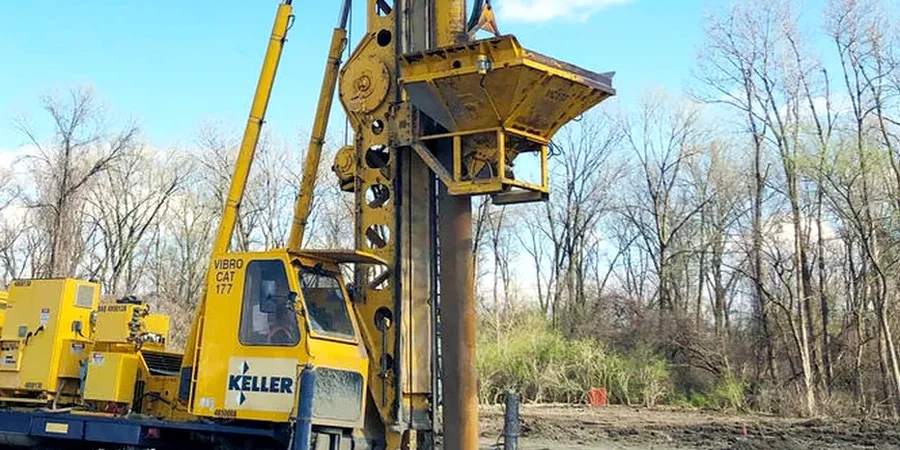
Technical reference image — Warrington

Site-specific factors

Eurocode 7 (BS EN 1997-1) requires ground investigation to be sufficiently detailed to identify ‘any looseness’ in granular strata, and Warrington’s buried river channels and glacial meltwater deposits make that obligation particularly relevant. A design that underestimates the lateral variability of fill or natural sand can lead to untreated lenses beneath a treated crust, producing differential settlement that cracks slab-on-grade floors and disrupts drainage falls. The second risk is over-compaction near existing structures: excessive vibration energy applied too close to a neighbouring warehouse or a Victorian sewer can trigger settlement in adjacent ground before it even reaches the design target. The design team mitigates this by establishing exclusion zones, specifying low-energy starts near sensitive assets, and installing vibration monitoring points tied to peak particle velocity limits referenced in BS 7385-2. A further concern is fines content: if laboratory grain-size analysis reveals silt or clay fractions above 12 to 15 percent, pure vibrocompaction loses effectiveness and the strategy shifts toward stone columns as a complementary ground improvement path.

Need a geotechnical assessment?

Reply within 24h.

Email: info@geotechnical-engineering.biz

Technical parameters

ParameterTypical value
Typical treatment depth in Warrington3 to 8 m (can reach 15 m with extension tubes)
Grid patternTriangular, 2.5 to 4.0 m spacing
Vibrator power range130 to 180 kW (electric/hydraulic)
Target relative density (Dr)>70% (post-treatment verification)
Applicable grain-size envelopeLess than 12% fines content (passing 75 µm)
Post-treatment verification methodsCPT, SPT, zone load test, shear-wave velocity
Design standardEurocode 7 (BS EN 1997-1) and BS 5930

Related services

01

Pre-Treatment Ground Investigation

CPT soundings, boreholes with SPT, and dynamic sampling to map the extent and grain-size distribution of loose granular deposits across the Warrington site before designing the grid.

02

Vibrocompaction Grid Design & Specification

Selection of vibrator energy, probe spacing, penetration depth, and phase sequencing, documented in a detailed method statement aligned with BS EN 1997 performance requirements.

03

Post-Treatment Verification Testing

Repeat CPT profiles, zone load tests, and shear-wave velocity measurements to confirm that target relative density and bearing capacity have been achieved across the treatment area.

04

Vibration Monitoring & Settlement Control

Installation of seismographs and settlement pins at sensitive boundaries, with real-time reporting against BS 7385-2 peak particle velocity limits to protect adjacent structures and buried utilities.

Reference standards

BS 5930:2015+A1:2020 – Code of practice for ground investigations, BS EN 1997-1:2004+A1:2013 – Eurocode 7: Geotechnical design (General rules), BS EN 1997-2:2007 – Eurocode 7: Ground investigation and testing, BS 7385-2:1993 – Evaluation and measurement for vibration in buildings, ICE Specification for Ground Treatment (current edition)

Common questions

What types of soil in Warrington respond best to vibrocompaction?

The method works best on clean, free-draining sands and gravelly sands with a fines content — particles passing the 75-micron sieve — below 12 percent. In Warrington’s geological setting, the glaciofluvial sands and granular made ground found along the Mersey floodplain and former industrial areas are ideal candidates. Soils with significant silt or clay layers do not densify under vibration alone and typically require a different approach, such as stone columns.

How long does a vibrocompaction design and treatment programme take for a typical Warrington industrial site?

Design and specification usually take two to three weeks once the pre-treatment ground investigation data is complete. On-site treatment for a 3,000-square-metre footprint with probes reaching 6 metres depth might run for 8 to 12 working days, depending on grid spacing and access constraints. Post-treatment verification testing follows immediately and results are typically reported within one week.

What is the typical cost range for vibrocompaction design and treatment in Warrington?

For a medium-scale project in the Warrington area, the combined design, mobilisation, treatment, and verification package generally falls between £1,190 and £3,820, depending on treated area, depth, grid spacing, and the extent of verification testing required. Each site is priced individually after reviewing the ground investigation data.

Can vibrocompaction be used close to existing buildings and buried utilities?

Yes, but it requires careful design. The specification must define exclusion zones, low-energy start-up procedures near sensitive structures, and vibration monitoring with peak particle velocity limits referenced to BS 7385-2. For assets within 5 metres of the treatment edge, the design often includes reduced grid spacing and phased compaction to control energy input while still achieving the required density improvement.
Location and service area

We serve projects in Warrington and surrounding areas.

View larger map