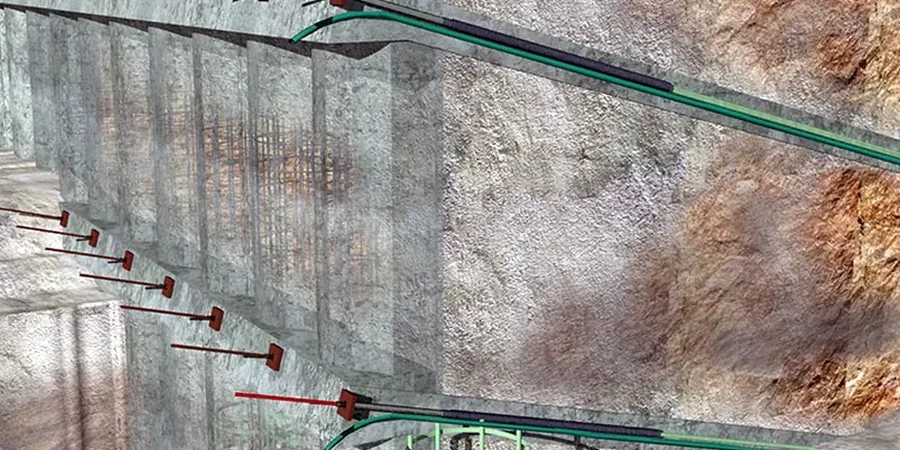
A crawler-mounted Klemm drill rig with a rotary-percussive head sets up on the Warrington site, its mast aligning to the designed inclination within half a degree. The duplex drilling method cuts through dense glacial till overlying the Chester Pebble Beds. Casing advances ahead of the hammer, preventing collapse in the saturated upper sands common north of the Mersey. Once the bond length reaches competent Sherwood Sandstone, the tendon — typically Dywidag bar or strand — is inserted and grouted under pressure. This is not a generic installation. Each anchor responds to the lateral earth pressures calculated from the BS EN 1997-1 Design Approach 1, where partial factors on actions and resistances govern the ultimate limit state. For temporary works in the town centre redevelopments along Bridge Street, we often combine drilled piles with multi-level anchors to manage the 8 to 12 metre cuts required for basement construction.
In Warrington's high-groundwater glacial till, a passive anchor without post-grouting loses half its bond — we prove this on every suitability test before production drilling.
Common questions
What is the difference between active and passive anchors?
Active anchors are pre-stressed after installation: a hydraulic jack tensions the tendon against the anchor head, locking in a force that compresses the retained ground and limits wall movement from the start. Passive anchors (often called soil nails) develop resistance only when the ground deforms and transfers load to the tendon — they do not receive a pre-load. In Warrington's soft alluvium near the Mersey, active anchors control lateral deflection far more effectively; passive nails suit stiffer materials or temporary slopes where some deformation is acceptable.
How much does anchor design and testing cost in Warrington?
The cost ranges from £830 to £3,310 depending on anchor type, design complexity, and testing requirements. A simple pull-out test on a soil nail falls at the lower end. A fully instrumented investigation anchor with multiple post-grouting phases, load cells, and a full design package to BS 8081 reaches the upper end. Mobilisation and drill rig day rates are additional and quoted per project.
Which British Standards govern ground anchor design?
Design follows BS 8081:2015+A1:2021 for grouted anchors, supplemented by BS EN 1997-1 (Eurocode 7 Part 1) for geotechnical design and BS EN 1997-2 for ground investigation. Execution on site adheres to BS EN 1537:2013. For temporary works, BS 5975 provides the procedural framework for design checks and site control.