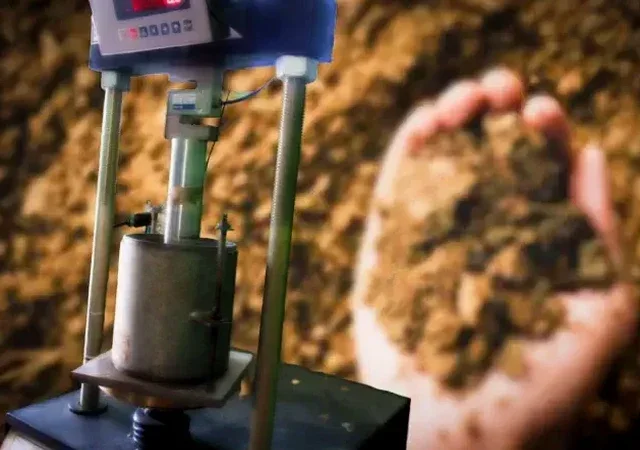
Warrington sits at a crossroads, not just of the M6 and M62, but geologically too. The town straddles the River Mersey, with alluvial deposits overlying the Sherwood Sandstone Group that underpins much of the region. At about 8 metres above sea level, the flat terrain hides a patchwork of glacial till, river terrace gravels, and pockets of soft clay that make every site different. In our experience, assuming uniform subgrade strength across a Warrington site is the fastest route to overdesign or premature pavement failure. That is why we run laboratory CBR tests on specimens compacted to the exact moisture and density conditions the contractor will achieve in the field. When the project involves a new industrial estate near Birchwood or a residential access road in Great Sankey, a single number from a desk study will not cut it. The soaked CBR value tells you how the formation will behave after a wet winter, which around here is the real test. We pair the laboratory CBR test with a proper site investigation, including test pits to recover representative samples from the depth that will actually support the pavement layers.
The soaked CBR value is the single most cost-effective parameter for preventing pothole-prone pavements in Warrington's variable glacial and alluvial soils.
Our approach and scope
Warrington's growth from a medieval market town to a designated New Town in 1968 left a legacy of engineered fills, reclaimed marshland, and buried infrastructure that influences every borehole log we produce. The Development Corporation era saw vast tracts of former agricultural land converted to residential and industrial use, often with fill of highly variable quality. Performing a laboratory CBR test on these materials is not a tick-box exercise; it requires careful specimen preparation that replicates the expected field density and moisture. The BS 1377-4 procedure we follow specifies compaction at a target moisture content, but the real skill lies in selecting that target from the Proctor curve to match the contractor's compaction specification. For projects requiring deep fill compaction verification, we complement the CBR with sand cone density testing and then correlate field density with laboratory strength. When the subgrade shows marginal CBR values below 2%, the design team needs to consider stabilization or a capping layer, and the laboratory data provides the baseline for that decision.
Site-specific factors
A few years back, a contractor started a car park expansion in Warrington without soaked CBR data, relying on a dry-weather plate test on the existing formation. The glacial till looked firm in August. By late November, with the drainage not yet connected and the stone sub-base saturated, the formation softened to the consistency of putty. The pavement design assumed a CBR of 5%; the actual soaked value came back at 1.5%. The result was a costly dig-out, import of additional capping layer material, and a three-week delay during the worst possible season. We see variations like this across the borough: the sandy lenses near the Mersey corridor drain freely and hold strength, but the laminated clays south of the Manchester Ship Canal are notorious for losing bearing capacity when wet. The laboratory CBR test exposes this risk before a tonne of asphalt goes down. For heavily trafficked industrial yards, we often recommend combining the soaked CBR with an in-situ permeability assessment to size the drainage system properly, because even a strong subgrade will fail if water cannot escape. Another lesson from the region: fill material brought to site needs its own CBR verification; we have seen imported 'granular fill' that barely reached 3% after compaction.
Reference standards
BS EN 13286-47:2021 – Unbound and hydraulically bound mixtures – Test method for the determination of California bearing ratio, immediate bearing index and linear swelling, BS 1377-4:1990 – Methods of test for soils for civil engineering purposes – Compaction-related tests, Eurocode 7 – BS EN 1997-2:2007 – Ground investigation and testing, Manual of Contract Documents for Highway Works (MCHW), Series 600 – Earthworks
Common questions
How much does a laboratory CBR test cost in Warrington?
For a single-point soaked CBR test including Proctor compaction and swell measurement, you are looking at £100 to £160 per specimen, depending on whether you need the standard or modified Proctor effort. A full suite with triplicate specimens and particle size distribution runs higher, but we quote per project once we know the number of samples and the testing specification. Volume discounts apply for larger site investigation programmes.
How long does the CBR test take from sample delivery to report?
The soaking period alone is 96 hours, so the absolute minimum turnaround is five working days. In practice, with compaction, soaking, penetration testing, and reporting, we typically deliver results within seven to ten working days. We can fast-track the immediate CBR component in three days if the soaked value is not required for the design stage you are at.
Do I need a soaked or unsoaked CBR value for my Warrington project?
For any pavement or road design in the UK, the soaked value is the standard because it represents the worst-case subgrade condition after water ingress. Warrington's water table is high in many areas, particularly near the Mersey and the canal corridors, so the soaked condition is almost always the governing case. We can run both and include the comparison in the report.
What soil types in Warrington are most problematic for CBR?
The laminated clays and silts of the glacial till, especially where they contain organic lenses, are the most challenging. They compact well at optimum moisture but collapse rapidly when soaked if the grading is poor. The alluvial deposits along the Mersey floodplain also show soaked CBR values well below 2% in some locations, which usually triggers a requirement for a capping layer or lime stabilization.