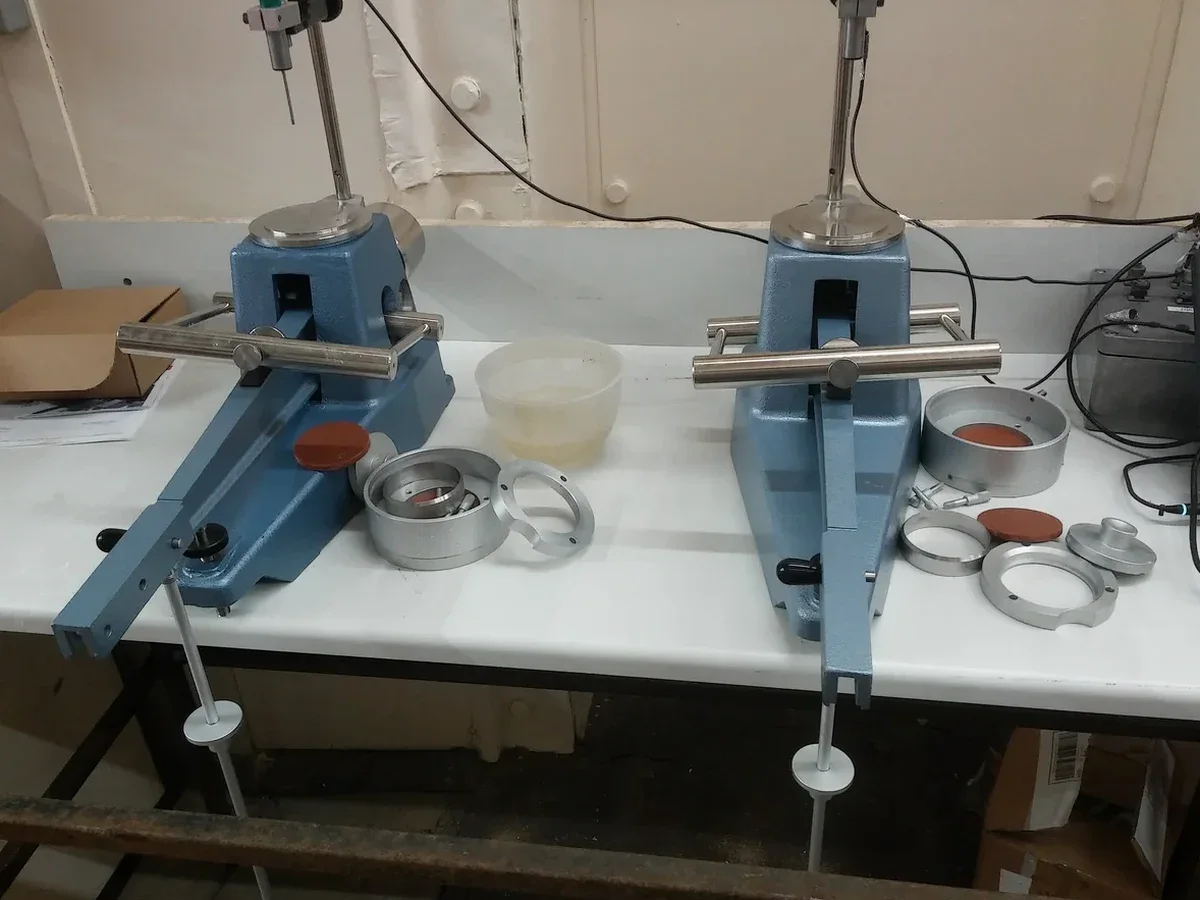
A common mistake on Warrington construction sites is assuming all clay behaves the same way. We see it often on the boulder clay outcrops near the Mersey floodplain. A contractor excavates, exposes a stiff grey material, and expects stable conditions. Then the first rain hits. The material softens, equipment bogs down, and the cut slope starts creeping. This happens because no one checked the Atterberg limits before breaking ground. The liquid limit and plastic limit define how a soil responds to water content change. Without that data, you are guessing. In a town where glacial till meets alluvial silts across short distances, that guess can cost you a foundation or a road base. Our lab runs the full BS 1377-2 procedure for every sample, delivering the plasticity index you need to classify the material correctly and predict its behaviour during wet winter months.
Two soil samples taken 500 metres apart in Warrington can have plasticity indices that differ by 25 percentage points. Classification changes everything.
Site-specific factors
One thing we notice on Warrington sites is that contractors underestimate how fast a low-plasticity silt can transition from workable to liquid. The area’s average annual rainfall sits around 800 mm, and the winter months deliver sustained wet weather with poor drying conditions. If you have a cut exposing silty clay with a plasticity index below 10, it takes very little water to push the material past its liquid limit. We have seen trench bases turn into slurry overnight after a moderate shower. The Atterberg limits give you the numerical threshold. The liquidity index ties it to field water content. When the LI creeps above 0.5, you are already in a softening zone. Above 1.0, the soil behaves as a viscous fluid. That is when trench collapses happen, and when compaction becomes impossible. For earthworks near the Mersey or the ship canal, where groundwater sits high, knowing your limits is not a paperwork exercise. It keeps the job moving and prevents rework that eats your programme. We combine Atterberg testing with in-situ permeability measurements when water sensitivity is a primary concern, giving you a complete picture of soil-water interaction.
Reference standards
BS 1377-2:1990 – Classification tests (liquid limit, plastic limit, plasticity index), BS EN ISO 14688-2:2018 – Identification and classification of soil for engineering purposes, Eurocode 7 (BS EN 1997-2:2007) – Ground investigation and testing for geotechnical design, Manual of Contract Documents for Highway Works (MCHW) Series 600 – Earthworks classification requirements
Common questions
How much does an Atterberg limits test cost for a Warrington project?
A standard Atterberg limits test, covering liquid limit and plastic limit on a single sample, costs between £50 and £80. Batch testing rates depend on the number of samples and whether additional tests such as particle size distribution are required. We can provide a fixed quote when you share the sample schedule.
Which BS 1377 method do you use for liquid limit?
We use the cone penetrometer method specified in BS 1377-2:1990, clause 4.3. This is the definitive method in the UK for fine-grained soils. We run the test at four different moisture contents, plot penetration against water content on a semi-logarithmic chart, and read the liquid limit at 20 mm penetration. This gives better repeatability than the older Casagrande cup method.
Can you test samples from deep boreholes or only shallow trial pits?
We test disturbed samples from any depth. The Atterberg limits are performed on the fraction passing a 425 µm sieve, so sample disturbance does not affect the result. Whether the material comes from a 1 metre trial pit or a 20 metre cable percussion borehole, the liquid limit and plastic limit values remain valid. We only need about 200 grams of material to run the full procedure.