Warrington’s industrial past means the ground beneath your feet is rarely straightforward. Between the River Mersey’s alluvial silts, pockets of glacial till left over from the last ice age, and decades of made ground from former tanneries and chemical works, a conventional borehole can only tell you so much. As a result, we rely heavily on the Cone Penetration Test to map these complex subsurface transitions in real time. The method generates a continuous profile of tip resistance and sleeve friction, which is essential when you need to identify how deep the competent Sherwood Sandstone actually sits beneath the fill. For logistics hubs near the M6 junction or residential blocks rising on old industrial plots, this data streamlines foundation design and keeps earthworks budgets predictable from day one.
A single CPT sounding near the Mersey can reveal 20 metres of stratigraphy in under two hours, giving the design team a continuous geotechnical signature that no borehole log can replicate.
Site-specific factors
A six-storey apartment block near Bank Quay was initially scoped with only trial pits. The logs showed stiff clay at 2 metres, and the developer was ready to proceed with a standard strip footing design. Our team recommended a supplementary CPT campaign, and the cone picked up a loose, water-charged silt lens at 4.5 metres — a layer that the excavator bucket had never reached. Without that continuous profile, differential settlement could have triggered cracking across the superstructure within the first two years of occupation. In Warrington’s floodplain environment, where artesian conditions can develop beneath the cohesive crust, skipping a pore-pressure measurement means you are effectively designing blind. The cost of mobilising a CPT rig is trivial compared to the remedial underpinning that follows a missed soft layer.
Common questions
How much does a CPT investigation cost for a typical Warrington site?
For a standard commercial investigation in the Warrington area, the cost of CPT Cone Penetration Testing typically falls between £120 and £190 per metre, depending on the required depth, the number of push locations, and whether you need piezocone (CPTu) with dissipation testing. Mobilisation to sites near the town centre or out toward Birchwood is factored into the day rate, and we can provide a fixed-price proposal once we have reviewed the site plan and the anticipated ground conditions.
Can CPT replace boreholes entirely on a brownfield site in Warrington?
CPT can significantly reduce the number of boreholes required, but it rarely replaces them entirely. The cone gives you a superb continuous strength and stratigraphy profile, but it cannot retrieve a physical sample for visual classification or laboratory testing. On Warrington’s brownfield sites, where the ground contains man-made fragments, we often use CPT as the primary investigative tool and then target one or two boreholes at locations where we need to verify the material composition or test for chemical contamination. This hybrid approach satisfies BS 5930 and keeps the overall investigation budget lean.
How deep can a CPT rig push in the ground conditions around the River Mersey?
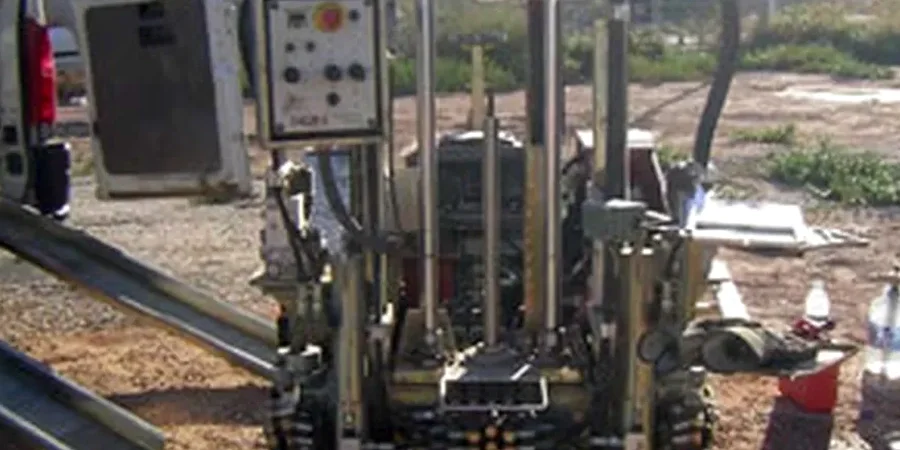
In the dense sands and gravels of the Sherwood Sandstone formation that underpin much of Warrington, our 50 kN heavy-duty crawler rig can typically reach depths of 25 to 30 metres before refusal. In the overlying alluvial clays and silts of the Mersey floodplain, the achievable depth is often greater, limited mainly by the thickness of the soft sediment sequence. We monitor the sleeve friction and inclination in real time, and if the cone starts to deviate or the thrust capacity is approached, we terminate the push to protect the equipment and maintain data integrity.