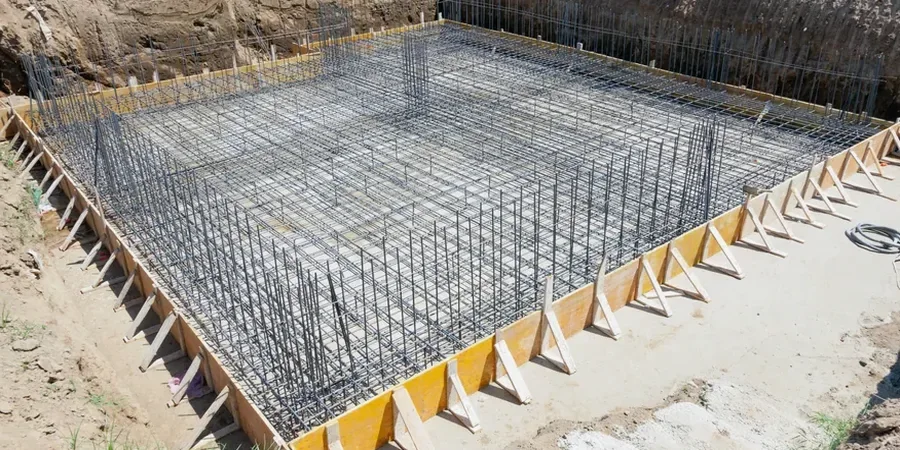
With a population topping 210,000 and sitting at just 8 metres above sea level on the banks of the Mersey, Warrington presents a unique set of ground challenges that flat slab or strip footings rarely handle well. We have seen too many projects stall because the initial ground investigation missed a thin layer of soft alluvium beneath stiff boulder clay. A raft foundation design spreads the structural load across a larger footprint, cutting down differential settlement in variable soils. Our lab team gets involved early, running consolidation and strength tests on Shelby tube samples pulled from the exact depth where the underside of the slab will sit. That data feeds directly into the bearing capacity and settlement calculations, ensuring the reinforced concrete mat is neither overdesigned nor underbuilt for the actual stratigraphy encountered on site.
A stiffened raft on variable glacial till can eliminate the cost and vibration risk of piling through historic mine workings.
Site-specific factors
BS EN 1997-1:2004 demands that we consider both ultimate and serviceability limit states, and in Warrington the serviceability case often governs because of the legacy of coal mining under the Permo-Triassic sandstone. Historic pillar-and-stall workings at shallow depth can collapse gradually, inducing trough subsidence that a conventional strip footing simply cannot ride out. A properly detailed raft foundation acts as a stiffened plate, but the design must include a mining subsidence assessment with a realistic ground strain profile. Ignoring this step leads to cracked slabs, jammed doors, and services pulled apart. We also watch for sulphate attack on buried concrete: the pyritic mudstones in the local Coal Measures can produce aggressive ground conditions that demand sulphate-resisting cement and thicker cover to reinforcement.
Common questions
What does a raft foundation design cost for a typical house plot in Warrington?
For a single residential plot the design package generally runs from £820 for a straightforward flat slab on competent till, up to around £3,320 when we need to integrate a mining subsidence assessment, beam-strip detailing, and a sulphate attack protection strategy.
How deep do you investigate below a proposed raft slab?
We follow the guidance in BS 5930 and BS EN 1997-2, typically extending boreholes to at least 1.5 times the raft width below the underside of the slab. In Warrington this often means terminating in the Sherwood Sandstone bedrock to confirm there are no deeper compressible layers or unrecorded mine entries.
Can a raft foundation cope with Warrington's mining subsidence?
Yes, and that is one of the main reasons it gets specified here. A stiffened raft with properly detailed reinforcement can bridge small to moderate subsidence troughs. The key is obtaining a Coal Authority report early and designing the slab for the specific ground strain and curvature predicted for the site.