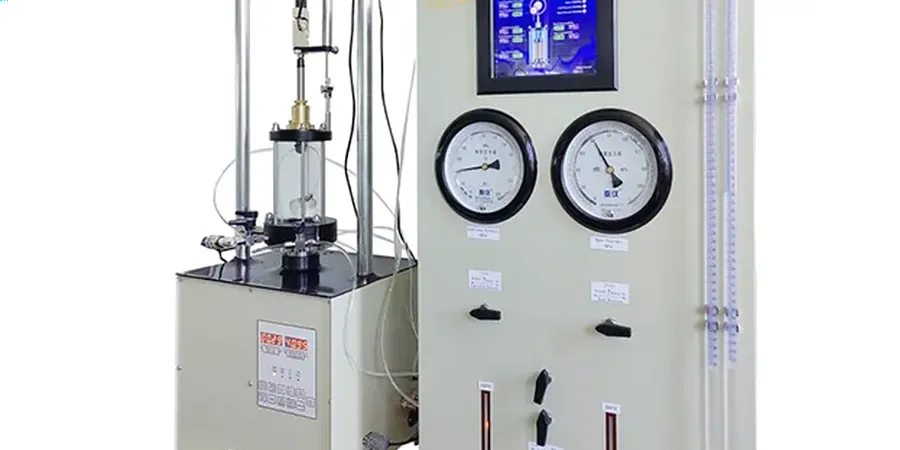
The ground beneath Warrington tells different stories depending on which side of the Mersey you stand. North of the river, glacial till and dense boulder clay sit firm underfoot, giving contractors a false sense of security before they move south into the softer alluvial silts and peat pockets near Latchford and Stockton Heath. That shift in soil behaviour can catch out even experienced ground engineers if the shear strength parameters aren't nailed down properly. A triaxial test in our lab replicates the in-situ stress conditions the soil will actually face under load, measuring both cohesive and frictional components. For projects on the Warrington waterfront or the new logistics parks off Junction 21 of the M6, we typically link triaxial data with our spt-drilling logs to build a complete ground model that avoids over-optimistic bearing capacity assumptions.
A triaxial test is not a single number. It's the stress path that tells you how the ground will actually fail under load.
Site-specific factors
Warrington sits at roughly 30 metres above sea level, but the real risk isn't elevation. It's the alluvial corridor along the Mersey where thicknesses of soft organic silt exceed four metres in places. A foundation bearing pressure of 150 kPa might seem reasonable based on a desk study, but if the soil is normally consolidated and the drainage path is long, excess pore pressure during loading reduces the effective stress regime dramatically. We've seen shear failures in temporary works near the river because the undrained strength was overestimated and the consolidation time underestimated. A multi-stage triaxial programme, run with realistic back pressures and careful saturation, exposes this vulnerability before the digger arrives. The Eurocode 7 design approach requires characteristic values derived from lab data, not rule-of-thumb tables. For Warrington's mixed ground conditions, that means actual triaxial curves, not assumptions.
Common questions
How much does a triaxial test cost in Warrington?
A standard three-specimen consolidated-undrained triaxial suite typically runs between £1,430 and £2,400, depending on specimen size, confining pressures, and whether you need drained stages or advanced stress paths. We provide a fixed quote after reviewing your borehole logs.
What's the difference between a UU and a CU triaxial test?
An unconsolidated undrained test gives total stress parameters and is faster, suitable for short-term stability on saturated clays. A consolidated-undrained test with pore pressure measurement yields effective stress parameters (c' and φ'), which account for drainage and pore pressure behaviour over the structure's life.
How many specimens do you need for a valid triaxial programme?
Three specimens at different confining pressures are the minimum to define a Mohr-Coulomb failure envelope. For heterogeneous ground like Warrington's alluvial deposits, we often recommend four or five specimens to capture variability and provide a statistically meaningful strength range.
Can you test the glacial till we find around Warrington?
Yes. The dense boulder clay north of the Mersey requires larger diameter specimens, typically 100 mm, to accommodate the coarse fraction. We trim carefully and saturate to a B-value above 0.95 before shearing at a rate slow enough to allow pore pressure equalization.
How long does a triaxial test programme take in the lab?
A three-specimen CU programme with full saturation and consolidation stages takes between seven and ten working days. Drained tests on low-permeability soils can extend to three weeks. We'll give you a realistic timeline when you submit the samples.