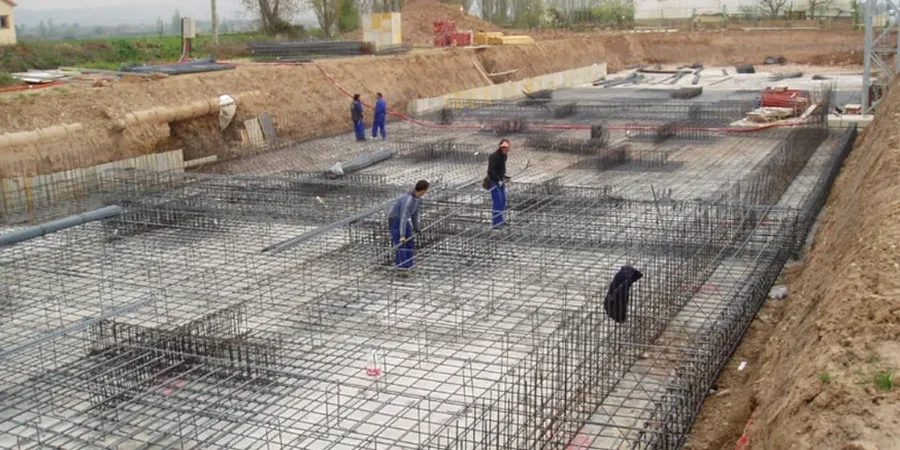
The application of BS EN 1997-1:2004 (Eurocode 7) is not a box-ticking exercise in Warrington—it is the only path to a safe and insurable foundation. The town straddles two very different geological units: dense Devensian glacial till to the north and soft alluvial deposits along the Mersey floodplain. A conservative presumptive bearing pressure taken from a desk study simply will not work here. Our laboratory team processes undisturbed samples from cable percussion boreholes, running consolidated undrained triaxial tests to extract the effective stress parameters that feed directly into the bearing capacity calculation. When the ground investigation reveals a variable stratum—which it does on almost every site south of the Ship Canal—the shallow foundation design must be checked for both bearing resistance and differential settlement. We also cross-reference the stiffness data with nearby MASW surveys to confirm that no deep soft lenses were missed between borehole positions, and we use the output from CPT testing to refine the depth of the bearing stratum where till cover is thin.
A shallow foundation in Warrington is only as reliable as the ground model behind it—glacial till and alluvium behave so differently that the design changes completely within a few hundred metres.
Our approach and scope
Warrington sits on a complex Quaternary sequence. The northern half of the borough is underlain by stiff, overconsolidated glacial till—the Stockport Formation—which often supports strip footings at shallow depth without issue. The southern half is different: alluvial silts and sands, sometimes with peat horizons, extend from the Mersey corridor toward Latchford and Stockton Heath. In those areas, we routinely encounter groundwater at less than 1.5 m below ground level during the winter months. That water table drives both the drained analysis in the short term and the potential for softening in the long term. Our shallow foundation design workflow for these sites starts with classification testing—
grain size analysis and Atterberg limits—to place the soil in the right behavioural group, then moves to effective stress triaxial tests on Shelby tube samples. The undrained shear strength from in-situ SPT data is calibrated against the lab result, and the final bearing resistance is calculated following Annex D of BS EN 1997-1. For lightly loaded structures on the till, we often validate the stiffness with a
plate load test before the concrete is poured, which gives the structural engineer a measured modulus of subgrade reaction rather than a textbook value.
Site-specific factors
The rig we deploy most often for shallow foundation investigations in Warrington is a tracked dynamic sampler with a windowless sampling barrel—compact enough to access rear gardens off Knutsford Road, yet capable of pushing through stiff till to the required depth. When the site investigation is skipped or reduced to a handful of hand-augered holes, the designer is left guessing whether the bearing stratum is continuous or whether a peat pocket sits right under the corner of the footing. We have seen precisely that scenario on a site near Sankey Brook: the desk study suggested competent till, but a 0.8 m thick peat layer was found at 2.2 m depth, completely changing the foundation solution. In alluvial zones, the biggest risk is differential settlement between pad footings founded on material with inconsistent stiffness. The UK National Annex to Eurocode 7 demands that the characteristic value of undrained shear strength be selected with statistical rigour—something impossible without a proper borehole log and lab programme. Underestimating the groundwater level is the other common failure mode; a shallow foundation designed for dry conditions can lose half its bearing capacity when the water table rises in winter and the effective stress drops.
Common questions
How much does a shallow foundation design package cost for a Warrington site?
For a typical residential or light commercial project in Warrington, the combined ground investigation, lab testing, and shallow foundation design report falls between £1,690 and £2,300. The spread depends on the number of boreholes, the depth of the bearing stratum, and the required lab testing suite—alluvial sites near the Mersey usually need oedometer and triaxial tests, which sit at the upper end of the range.
How deep do shallow foundations need to be in Warrington's glacial till?
In the stiff Stockport Formation till north of the town centre, strip footings at 0.9–1.2 m depth typically reach competent bearing strata. We always confirm this with dynamic sampling—frost susceptibility is minimal, but desiccation cracks in the upper 0.6 m can reduce stiffness, so the footing must be below the zone of seasonal moisture fluctuation.
What is the difference between Design Approach 1 and Design Approach 2 for shallow foundations?
The UK National Annex mandates Design Approach 1 (DA1) for shallow foundations, which means we check two combinations: Combination 1 applies partial factors to actions (A1) and material strengths (M1), while Combination 2 applies factors to actions (A2) and material strengths (M2). DA2 is not used for spread footings in the UK—it is reserved for pile and anchor design under certain conditions. Our reports always run both DA1 combinations and present the more conservative result.
Can you design shallow foundations in Warrington's flood zones?
Yes—a significant portion of Warrington south of the Mersey falls within Flood Zones 2 and 3. For these sites, the shallow foundation design must account for the buoyant unit weight of the soil and the potential for scour. We typically deepen the footing to below the anticipated scour depth, and we run the bearing capacity analysis with the groundwater at ground surface as a conservative scenario. The Environment Agency's standing advice for flood risk is incorporated into the Geotechnical Design Report.