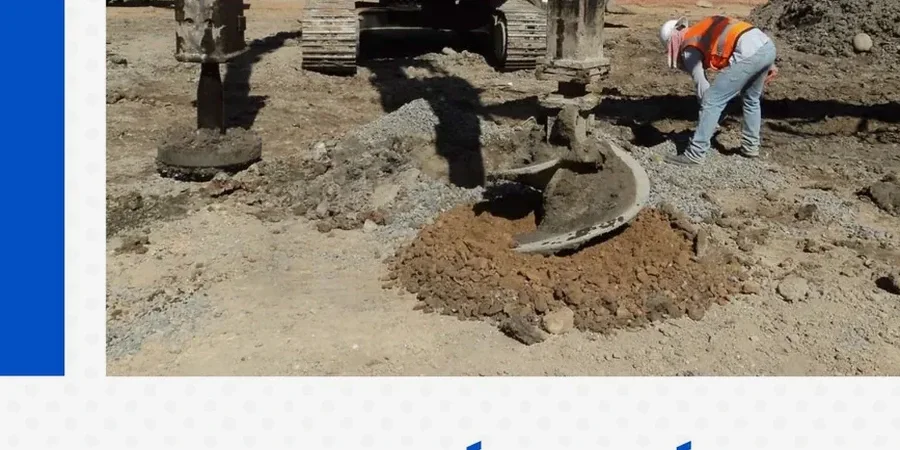
The persistent dampness of the Cheshire Plain, where Warrington sits astride the River Mersey, creates a particular set of challenges for anyone building on its floodplains. You are rarely dealing with competent rock here; instead, the superficial geology tends to be soft alluvial clays, silts, and occasional peat lenses, remnants of the river's meandering history. This is precisely where a vibro stone column design becomes not just an option but the most logical path forward. Rather than excavating vast quantities of poor material and importing engineered fill, ground improvement with stone columns provides a load-transfer mechanism that works with the in-situ soil, reinforcing it vertically and accelerating drainage. For a logistics hub or a commercial park going up near the M62 corridor, the technique effectively transforms a problematic subgrade into a competent foundation stratum without the carbon footprint of deep piling. We routinely verify the design assumptions with in-situ testing, and many engineers in the region combine this approach with a CPT test to map the precise thickness of the compressible layers before finalising the column grid.
In the Mersey floodplain, vibro stone columns can cut consolidation settlement time from years to weeks by creating radial drainage paths that dissipate excess pore pressure rapidly.
Site-specific factors
BS EN 1997-1:2004 (Eurocode 7) requires ground investigations to cover sufficient depth to identify any compressible layers that could influence the performance of deep ground improvement. In Warrington, this carries particular weight because the buried peat horizons within the alluvial sequence can be easily missed by a standard borehole that terminates too early. A stone column that penetrates the soft clay but stops just above a thin, undetected peat lens will not prevent long-term differential settlement; the column might look fine on a post-installation check, but the underlying organic material will continue to compress under load, potentially leading to cracking in a finished slab within the first two years. The design therefore demands a thorough stratigraphic model, often refined through correlations with in-situ permeability testing to understand the consolidation regime under surcharge. The team also checks against the possibility of a 'bulging failure' in the upper portion of the column, a known risk when the surrounding soil cannot provide adequate lateral confinement—something that becomes critical in areas where the soft clay is overlain by a stiffer desiccated crust that masks the weakness below.
Common questions
What makes stone columns suitable for the ground conditions in Warrington?
The technique works well in the soft alluvial clays and silts of the Mersey floodplain, where undrained shear strengths are typically 15 to 40 kPa. Stone columns reinforce the soil through compaction and provide radial drainage, which accelerates consolidation settlement under embankment or slab loading, making the ground buildable without deep piled foundations.
How do you ensure the columns do not fail by bulging in very soft ground?
Bulging failure occurs when the surrounding soil cannot provide enough lateral restraint to the stone column. The design addresses this by checking the critical depth, typically the upper two to three column diameters, where confining stress is lowest. If the clay is very soft near the surface, the design may incorporate a load transfer platform of well-compacted granular fill to distribute stresses and reduce the demand on the uppermost column section.
What is the typical cost range for a stone column design package in Warrington?
For a ground investigation, interpretative report, detailed design, and method statement for a commercial site in the Warrington area, the design package typically falls between £1,200 and £4,430, depending on the complexity of the ground profile, the size of the treatment area, and the number of verification tests required.
Which British Standards govern the design and execution of stone columns?
The primary design standard is BS EN 1997-1:2004 (Eurocode 7), which sets out the limit state design philosophy for geotechnical structures. The execution is covered by BS EN 14731:2005, which specifies the methods for deep vibration ground treatment. The ground investigation that feeds the design follows BS 5930:2015+A1:2020, and the stone aggregate itself must comply with BS EN 13242 for civil engineering applications.